Prefab Home Prices 2026: Current Price Table and a Guide to the Right Decision
Current 2026 prefab home prices in a single table: turnkey starting prices from 999.000 TL for 48 m² 1+1 models up to 2.249.000 TL for 100 m² 3+1 two-storey models, plus the logic of cost per m² and what to look out for when requesting a quote.
How Much Do Prefab Homes Cost in 2026?
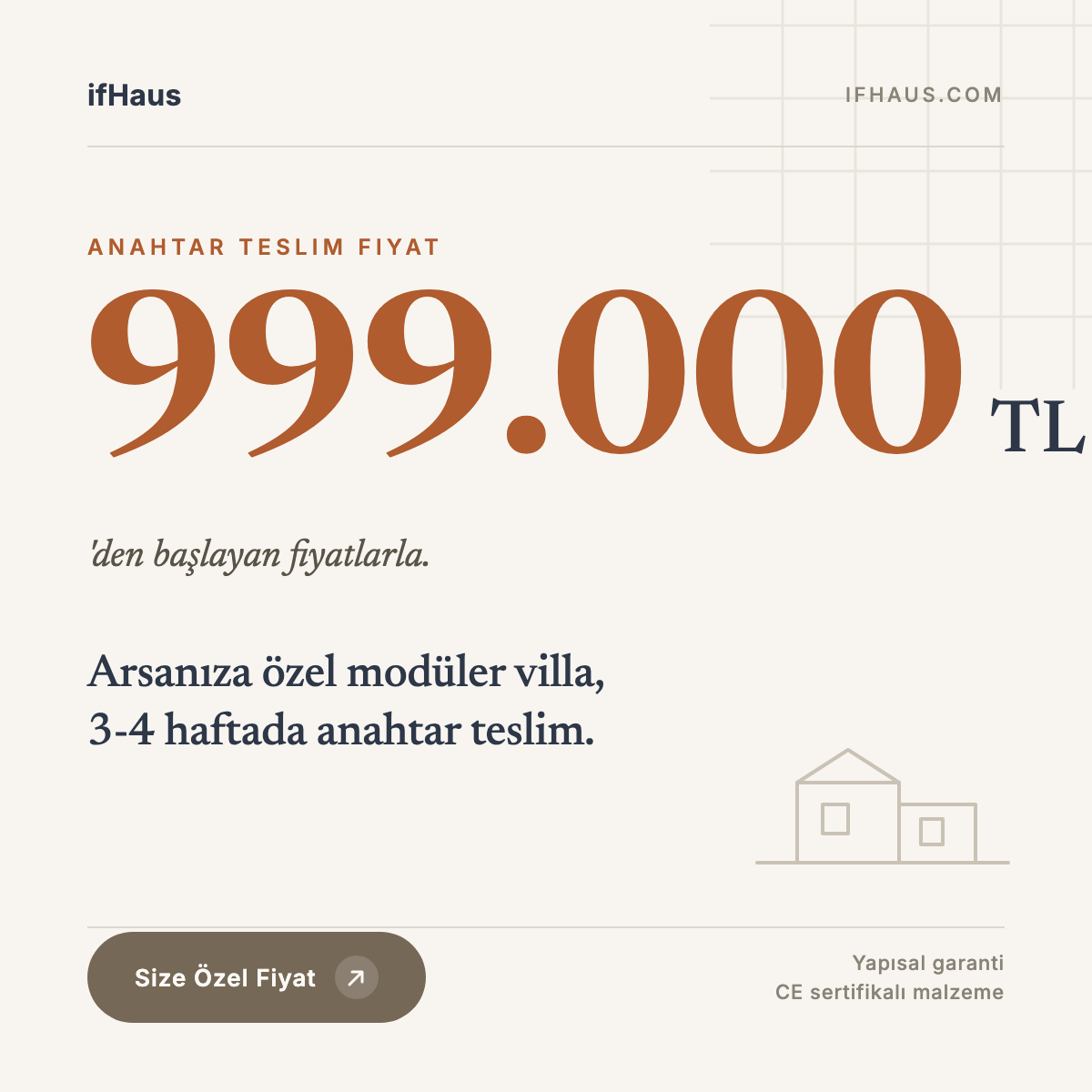
In 2026, turnkey prefab and modular home prices vary with the delivery scope; across ifHaus modular villas, starting prices range from 999.000 TL for the 48 m² 1+1 Villa İz to 2.249.000 TL for the 100 m² 3+1 two-storey Villa Yuva. In the mid sizes, the 66 m² 3+1 Villa Form sits at 1.449.000 TL and the 86 m² 3+1 Villa Vadi at 1.999.000 TL. These are turnkey starting prices; the final cost is confirmed according to the location of your plot, its ground conditions and its infrastructure needs.
Even so, there is no such thing as a single, fixed “prefab home price”; two buildings of the same size can end up at very different figures depending on material level and delivery scope. In this guide we first share the current model prices in a table, then walk step by step through what drives the price, which items are and are not included, and how to request a quote the right way.
Current Prefab Home Price List: ifHaus Models (2026)
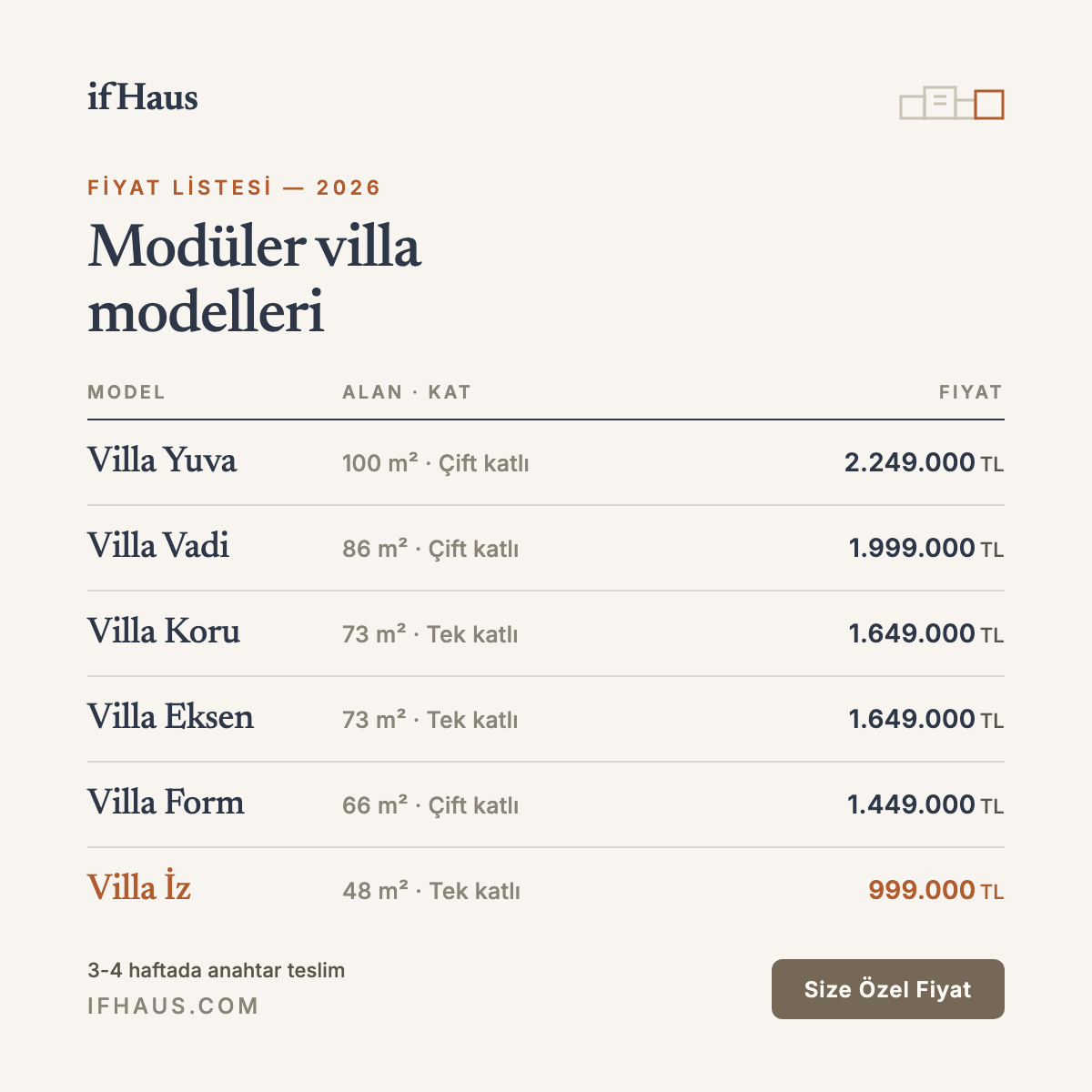
The table below shows the turnkey starting prices of ifHaus modular villa models as of 2026. You can explore the floor plans, façade visuals and up-to-date details on the models page of our site (/modeller).
When reading the table, we recommend looking not only at the total price but also at the floor area, the number of rooms and the storey configuration together. Within the same budget band there may be several models that suit different living scenarios.
For a summary table of current prices per m², see the /prefabrik-ev-fiyat-endeksi page.
| Model | m² | Rooms | Storeys | Starting Price |
|---|---|---|---|---|
| Villa İz | 48 m² | 1+1 | Single storey | 999.000 TL |
| Villa Form | 66 m² | 3+1 | Two storeys | 1.449.000 TL |
| Villa Koru | 73 m² | 2+1 | Single storey | 1.649.000 TL |
| Villa Eksen | 73 m² | 3+1 | Single storey | 1.649.000 TL |
| Villa Vadi | 86 m² | 3+1 | Two storeys | 1.999.000 TL |
| Villa Yuva | 100 m² | 3+1 | Two storeys | 2.249.000 TL |
Prices are the turnkey starting prices of ifHaus modular villa models (2026). The final price may vary according to the location of the plot, ground and infrastructure conditions, and optional requests.
The Logic of Cost per Square Metre: How to Read the Price Table
One of the soundest ways to compare prefab home prices is to divide the total figure by the floor area and look at the unit cost. In the 48 m² Villa İz at 999.000 TL, for example, the cost per square metre is roughly 20.800 TL, while in the 100 m² Villa Yuva at 2.249.000 TL it is roughly 22.500 TL. This value varies from model to model according to the floor plan, the number of rooms and the storey configuration.
The unit cost is not constant, because what really generates cost is not empty space but the content of the floor plan. As the number of rooms increases, so do partition walls, doors, windows and service points; wet areas such as the kitchen and bathroom are the most expensive parts of a home per square metre. On the other hand, fixed items such as production, transport and installation weigh more heavily in the total on smaller projects. The balance of these two effects explains why the unit price differs from model to model.
Another critical point when comparing is that companies may calculate floor area differently: there can be a serious gap between gross area, net usable area, and measurements that include terraces and eaves. For a sound m² comparison, always ask which area the price is based on.
Why Do Prefab Home Prices Differ So Much?
In recent years, prefab home prices have become one of the most researched topics among people looking for a home. The main reason is clear: people no longer simply want to own a house; they are looking for solutions that move faster, can be planned within a more controlled budget and raise their quality of life.
Anyone researching prefab home prices online very quickly runs into widely differing figures. The reason is that not every prefab home comes with the same scope. The price of a home is not set by its size alone; even between two buildings of the same floor area there can be a serious price gap.
That is why, when looking at prefab home prices, you should look not at a single number but at what sits inside that price. Many factors affect it directly: floor area, number of storeys, material level, transport, interior scope and the form of delivery.
What Are the Key Factors Behind Prefab Home Prices?
The most fundamental factor in prefab home prices is floor area. As sizes such as 60 m², 80 m², 100 m² or 120 m² grow, the total cost rises with them. The important point, however, is that the unit price does not always stay the same as the floor area increases.
In some cases, the unit cost can be higher in smaller homes. This is because fixed production and installation items weigh more heavily in smaller projects.
There can also be a difference between single-storey and two-storey prefab home prices. In two-storey solutions the staircase, the structural arrangement, the organisation between floors and the overall planning all differ, so the cost structure changes too. When reviewing prefab home prices, consider not only the area but also how many storeys the building has.
Another factor is the production method. Building components prepared in a factory environment, under controlled conditions, reduce material wastage, workmanship errors and schedule-driven cost overruns. This is the main reason the price of modular production is more predictable than that of conventional construction.
How Do Material Quality and Delivery Scope Affect the Price?
The exterior cladding, interior wall build-up, window systems, doors, flooring materials and kitchen and bathroom fittings all affect the price significantly. From the outside, two homes may look similar, yet there can be a substantial gap between the material levels used. When evaluating prefab home prices, it therefore matters more to understand the technical scope than the visuals.
One of the most overlooked topics is the delivery scope. Some prices cover only the main system of the building, while others may also include interior works, the kitchen, the bathroom, doors, window systems and various details. In other words, when quotes from two companies are far apart, the reason is usually a difference in delivery scope rather than in the product itself.
Prefab home prices can also change according to the province where the plot is located and its access conditions. Long distances, difficult access or special site requirements can increase the total cost.
On the materials side, the broad trend of 2026 is rising demand for thermal insulation, energy efficiency and long-life façade materials. Since cost movements in core items such as steel, insulation and joinery can feed into home prices from time to time, it is important to ask how long a quote remains valid and to work from the current price list.
Transport, Foundations and Infrastructure: Items to Budget Beyond the Home Price
The most frequently overlooked truth when budgeting for a prefab home is this: the home price is not the only line in the project. On the plot side, three main headings stand out. First, the foundations: engineered according to the ground survey, they cost differently depending on the slope of the plot and the soil class. Second, transport: the distance between the production facility and the plot, road access and any crane requirement all affect the total. Third, infrastructure: electricity, water and sewerage connections, or a septic tank solution, vary from plot to plot.
To these you can add the fees attached to the building permit and design stages, plus personal choices such as landscaping. Because these items differ on every plot, they are usually kept outside the standard list price. The right approach is to share your plot details and request a written, clearly scoped quote in which these items are confirmed alongside the home price.
What to Watch for When Researching Prefab Home Prices in 2026
The most common mistake among people researching prefab home prices in 2026 is treating the first figure they see as the true final price. The right approach is to view the starting price, learn the delivery scope, pin down the floor area, state where the plot is located and ask about additional costs.
That way, the gap between the advertised price and the real project cost becomes far easier to see.
A practical checklist runs as follows: When was the price given? Is it turnkey or shell only? Is the floor area gross or net? Are transport and foundations included? How long is the quote valid? If the answers to these five questions are clear, figures from different companies can be compared on the same footing.
Are Cheap Prefab Home Prices Always a Good Deal?
The short answer: no. Prefab home prices that look low at first glance can be tempting, but a low price does not always mean a better option. In some cases the buyer only sees the main structure, and additional items later push the total cost far higher than expected.
The right approach is to look not at the cheap price alone, but at the balance between price, quality and scope.
Prices noticeably below the market average usually carry at least one of three risks: items left out of scope (interior finishes, joinery, services), a low material standard (inadequate insulation, thin profiles, budget-grade joinery) or an unclear delivery process. A home is a building you will live in for many years, so a small saving at the start can come back as heating bills, maintenance costs and lost comfort.
The Differences Between Single-Storey and Two-Storey Prefab Home Prices
Single-storey solutions suit people who want a simpler, more compact living plan. Two-storey solutions, in turn, can offer more usable space on the same footprint. This difference can affect cost across many headings, from the structural solution to the interior organisation.
That is why the single-storey or two-storey question should be answered not by price alone, but together with your living scenario.
The reason for the price difference is structural: two-storey solutions add a staircase, an intermediate floor, extra structural details and a longer assembly time to the cost; in return, far more usable space is gained from the same footprint. At ifHaus, for example, the 66 m² two-storey Villa Form offers 3+1 living on a compact footprint at 1.449.000 TL, while the 73 m² single-storey Villa Eksen resolves the same number of rooms in a horizontal plan at 1.649.000 TL. On small plots two storeys are usually the more efficient choice; on wide, flat plots a single storey often serves those who want horizontal living best.
Why Are 60 m², 80 m² and 100 m² Prefab Home Prices Searched So Often?
Because most people first want to see the size closest to their own needs. Searches such as 60 m², 80 m² and 100 m² prefab home prices show that a person is trying to match their own budget to their own living scenario.
Someone considering a small second home, for instance, researches 60 m² solutions, while someone who wants family-sized living space looks into options around the 100 m² level.
To map these size bands onto the current table: the closest option to the 60 m² band is the 66 m² Villa Form (1.449.000 TL); in the 80 m² band it is the 86 m² Villa Vadi (1.999.000 TL); and in the 100 m² band, Villa Yuva (2.249.000 TL) is the concrete reference. That way, questions such as “how much is an 80 m² prefab home?” can be answered with a real model price rather than rough estimates.
The 5 Details to Provide When Requesting a Quote
The right price starts with the right information. To speed up the quoting process and receive a meaningful figure in the very first conversation, keep these five details ready:
1. Location of the plot: province, district and, if possible, neighbourhood. Transport planning and the assessment of site conditions start here.
2. Condition of the plot: approximate size, slope, road access and zoning status. This determines which model can be placed on the land.
3. Desired size and plan: target floor area, number of rooms (1+1, 2+1, 3+1) and single-storey / two-storey preference.
4. Intended use: full-time living, a weekend home or a rental investment. This directly shapes insulation and equipment priorities.
5. Timeline and budget range: when you want to move in and the budget band you have in mind. This helps pin down the most suitable model quickly.
The clearer these details are, the more realistic and comparable the price you receive will be.
How to Get the Most Accurate Prefab Home Price
The most accurate price comes not from browsing figures online, but from sharing your needs and your plot details. The ideal process runs like this: first clarify your needs, then share the condition of your plot, identify the right model or solution, learn the delivery scope and evaluate the real price on that basis.
This method both avoids wasted time and leads to a more accurate outcome.
When evaluating a quote, ask for the scope list in writing. Seeing the “included” and “excluded” items line by line both prevents surprise costs and makes quotes from different companies genuinely comparable.
Why Should Anyone Researching Prefab Home Prices Look at ifHAUS?
ifHAUS aims to offer not just a home price, but a modern solution matched to your needs and your plot. In this approach, what matters is not only the floor area; it is the quality of the plan, the architectural character, the technical approach, living comfort and the right placement on the land.
The goal at ifHAUS is therefore not merely to display a price, but to offer each customer the genuinely right solution.
On pricing, our approach is transparency: the turnkey starting prices of every model, from Villa İz to Villa Yuva, are published openly; instead of “call for price” ambiguity, we start the conversation from the figure you see in the table. You can explore the floor plans and details of the models on the /modeller page and request a tailored quote for the solution that suits your plot.
Conclusion: What Really Matters in Prefab Home Prices?
When researching prefab home prices, the key point is this: a single figure never tells the whole story. A sound evaluation looks at price, technical scope and quality of life together.
As of 2026, turnkey starting prices across ifHaus modular villas range from 999.000 TL (48 m² Villa İz) to 2.249.000 TL (100 m² Villa Yuva). The right figure for you, however, is not the lowest price on the list; it is the price of the model that fits your plot and your living scenario.
Because a good home is not merely affordable; it is well planned, well built and genuinely right for you.
If you want clear information on prefab home prices and to see the solution that suits your own plot, a professional quote prepared around your needs is the soundest place to start.
FAQ
Questions on your mind
What price does the cheapest prefab home start at?
Although the market shows a wide range of figures, the 2026 starting point for a turnkey modular home at ifHaus is 999.000 TL for the 48 m² 1+1 Villa İz. For prices noticeably below this level, it is worth examining carefully what the delivery scope actually includes.
How much is a 100 m² prefab home?
As of 2026, the turnkey starting price of the 100 m² 3+1 two-storey Villa Yuva at ifHaus is 2.249.000 TL. The final figure is confirmed according to the location of your plot and its ground and infrastructure conditions.
What is included in prefab home prices?
It depends on the delivery scope. Some prices cover only the main structure, while turnkey prices also include items such as the exterior cladding, window and door joinery, interior finishes, and kitchen and bathroom installations. Plot-related items such as foundations, transport and site infrastructure are usually calculated separately; the safest approach is to request the scope list in writing.
Why do prefab home prices vary?
Because the price varies with many factors, including floor area, number of storeys, material quality, delivery scope, transport and plot conditions.
Is the price of a 100 m² prefab home fixed?
No. Even at the same floor area, different prices can arise depending on the floor plan, materials and delivery scope.
Are single-storey prefab homes cheaper?
Not always. Single-storey solutions often look simpler, but the price can change depending on the overall floor plan and material specification.
Which is cheaper: a prefab home or reinforced concrete?
At a similar floor area and quality level, modular buildings offer a more predictable total cost in most scenarios, thanks to controlled factory production and a short time on site; with reinforced concrete, the risk of cost overruns from labour, schedule and material wastage is higher. A definitive comparison should still be made based on the plot, the design and the choice of materials.
Is buying a cheap prefab home a good idea?
Deciding on a low price alone is not the right approach. First you need to understand what that price actually covers.
What information should I give when asking for a prefab home quote?
The most important details are the location and size of your plot, your preferred floor area, the number of storeys and the intended use.
ifHaus
Let's plan the prefab home solution that fits your land and needs together
Let's evaluate the right pricing approach together, based on the model and scope that suit you.
Keep reading